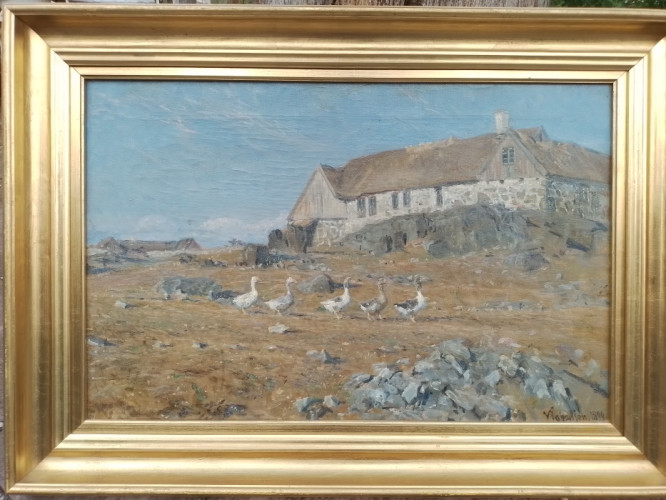
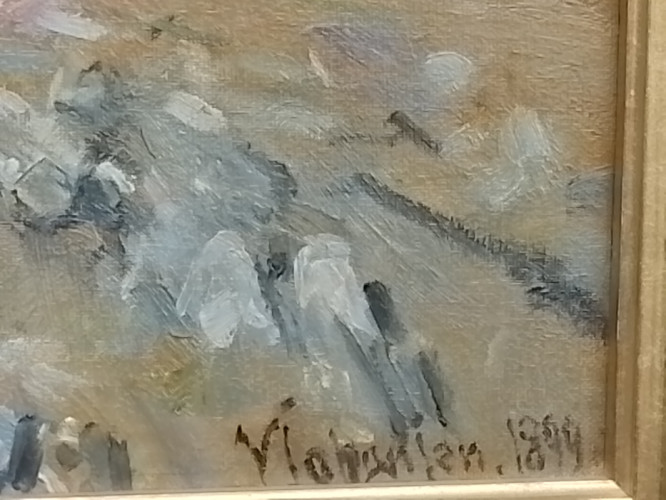
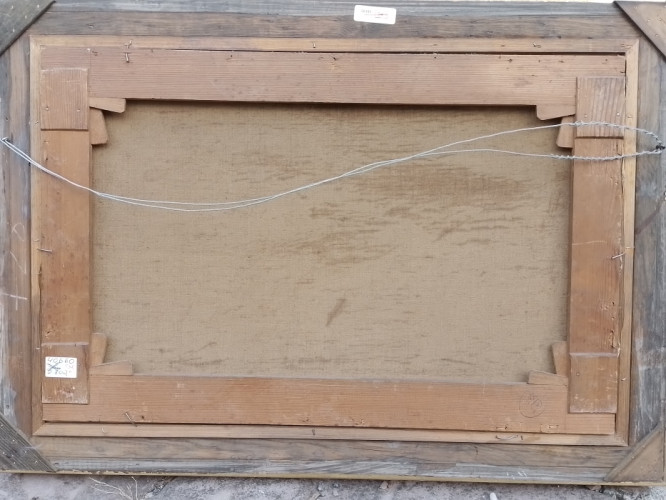
Viggo Johansen homestead with flock of geese
Price:
On request
Product details
| Product number: | 1227 |
| Artist: | Viggo Johansen ( 1851-1935 ) |
| Style: | Impressionism |
| Material: | Oil canvas |
| Dimensions: | 45 x 70 cm |
Product description
Viggo Johansen (1851–1935)
Born in Copenhagen, died in 1935
The master of atmosphere
Viggo Johansen is one of the important representatives of Danish Skagen painting. He became particularly known for his sensitive depictions of domestic life and atmospheric interiors. Following in the tradition of Danish Golden Age painting, he combined romantic sensibilities with a keen sense of light, color and atmosphere. His intimate interior scenes captivate with their poetic charisma and painterly charm. His landscapes from Skagen also show the influence of French Impressionism, whose light-flooded colors Johansen interpreted in an independent way.
Skagen, Martha Møller and the circle of artists
At the age of 17, Viggo Johansen began his studies at the Royal Danish Academy of Art in Copenhagen, where he initially concentrated on figure painting, which was highly regarded at the time. Although he did not complete his studies, he developed into an independent and respected artist.
At the suggestion of his fellow student Michael Ancher, Johansen traveled to Skagen for the first time in 1875. The northern Danish coastal town developed into an important meeting place for Scandinavian artists. There he met Martha Møller, a cousin of the painter Anna Ancher. The couple married in 1880 and in the following years spent numerous summers with their growing family in Skagen, where they were part of the close circle of local artists.
Masters of lighting mood – important works
In addition to his own artistic work, Johansen also devoted himself to teaching. He taught at the Free Art School in Copenhagen and at the Women's Art School at the Royal Danish Academy of Art. From 1906 to 1920 he worked there as a professor.
His special mastery is particularly evident in the interior paintings, in which he transformed everyday domestic situations into impressive, atmospherically dense picture compositions. Through the delicate interplay of light, color and shadow, he gave his motifs a remarkable liveliness and emotional depth.
One of his most famous works is the painting “Glade jul” (Silent Night), created in 1891, which is now in the Hirschsprung Collection in Copenhagen. Also outstanding is the 1899 painting “Aftenselskab i mit hjem” (Evening Party in My Home), which is kept in the Danish National Gallery.
Viggo Johansen left behind an important artistic work that combines the tradition of Danish painting with the new painterly impulses of Impressionism. His ability to imbue even everyday scenes with poetic mood and subtle lighting makes him an important representative of Danish art of the late 19th and early 20th centuries.
Art historical classification: Skagen painting around 1899
The year 1899 fell into an important phase in Danish painting, in which the naturalistic depiction of reality increasingly combined with the achievements of French Impressionism. The artists' colony of Skagen had established itself as an important center of this development since the 1870s. What was characteristic were the direct observation of nature, the examination of the special lighting conditions of northern Jutland and an increasingly free, atmospheric style of painting.
Viggo Johansen occupied an independent position within this circle of artists. While colleagues like Michael Ancher focused primarily on the lives of fishermen and P. S. Krøyer often discussed the special lighting atmosphere on the beaches, Johansen also focused his attention on the quieter, less spectacular sides of the northern Danish landscape. Aside from the large seascapes and representative figure compositions, he was interested in inconspicuous corners, rural properties and everyday wildlife. It is precisely in such motifs that his special sensitivity for the poetic effect of the
Viggo Johansen belongs to the generation of Danish painters who, at the end of the 19th century, combined the academic tradition with a direct, life-like observation of nature. His particular strength lay in his ability to capture the atmosphere of a place and the quiet poetry of everyday situations.
A painting of a flock of geese in front of a rocky farm in Skagen, created in 1899, is thematically consistent with this artistic conception. The combination of animal depictions, rural architecture and Nordic landscape opens up a characteristic view of the less representative, but more immediate side of life on the northern tip of Denmark. The work can therefore be placed in the broader context of Skagen painting around 1900, in which nature, light and everyday reality became independent pictorial themes.
Born in Copenhagen, died in 1935
The master of atmosphere
Viggo Johansen is one of the important representatives of Danish Skagen painting. He became particularly known for his sensitive depictions of domestic life and atmospheric interiors. Following in the tradition of Danish Golden Age painting, he combined romantic sensibilities with a keen sense of light, color and atmosphere. His intimate interior scenes captivate with their poetic charisma and painterly charm. His landscapes from Skagen also show the influence of French Impressionism, whose light-flooded colors Johansen interpreted in an independent way.
Skagen, Martha Møller and the circle of artists
At the age of 17, Viggo Johansen began his studies at the Royal Danish Academy of Art in Copenhagen, where he initially concentrated on figure painting, which was highly regarded at the time. Although he did not complete his studies, he developed into an independent and respected artist.
At the suggestion of his fellow student Michael Ancher, Johansen traveled to Skagen for the first time in 1875. The northern Danish coastal town developed into an important meeting place for Scandinavian artists. There he met Martha Møller, a cousin of the painter Anna Ancher. The couple married in 1880 and in the following years spent numerous summers with their growing family in Skagen, where they were part of the close circle of local artists.
Masters of lighting mood – important works
In addition to his own artistic work, Johansen also devoted himself to teaching. He taught at the Free Art School in Copenhagen and at the Women's Art School at the Royal Danish Academy of Art. From 1906 to 1920 he worked there as a professor.
His special mastery is particularly evident in the interior paintings, in which he transformed everyday domestic situations into impressive, atmospherically dense picture compositions. Through the delicate interplay of light, color and shadow, he gave his motifs a remarkable liveliness and emotional depth.
One of his most famous works is the painting “Glade jul” (Silent Night), created in 1891, which is now in the Hirschsprung Collection in Copenhagen. Also outstanding is the 1899 painting “Aftenselskab i mit hjem” (Evening Party in My Home), which is kept in the Danish National Gallery.
Viggo Johansen left behind an important artistic work that combines the tradition of Danish painting with the new painterly impulses of Impressionism. His ability to imbue even everyday scenes with poetic mood and subtle lighting makes him an important representative of Danish art of the late 19th and early 20th centuries.
Art historical classification: Skagen painting around 1899
The year 1899 fell into an important phase in Danish painting, in which the naturalistic depiction of reality increasingly combined with the achievements of French Impressionism. The artists' colony of Skagen had established itself as an important center of this development since the 1870s. What was characteristic were the direct observation of nature, the examination of the special lighting conditions of northern Jutland and an increasingly free, atmospheric style of painting.
Viggo Johansen occupied an independent position within this circle of artists. While colleagues like Michael Ancher focused primarily on the lives of fishermen and P. S. Krøyer often discussed the special lighting atmosphere on the beaches, Johansen also focused his attention on the quieter, less spectacular sides of the northern Danish landscape. Aside from the large seascapes and representative figure compositions, he was interested in inconspicuous corners, rural properties and everyday wildlife. It is precisely in such motifs that his special sensitivity for the poetic effect of the
Viggo Johansen belongs to the generation of Danish painters who, at the end of the 19th century, combined the academic tradition with a direct, life-like observation of nature. His particular strength lay in his ability to capture the atmosphere of a place and the quiet poetry of everyday situations.
A painting of a flock of geese in front of a rocky farm in Skagen, created in 1899, is thematically consistent with this artistic conception. The combination of animal depictions, rural architecture and Nordic landscape opens up a characteristic view of the less representative, but more immediate side of life on the northern tip of Denmark. The work can therefore be placed in the broader context of Skagen painting around 1900, in which nature, light and everyday reality became independent pictorial themes.