Max Werner Baltic Sea in Fischland Darß -Sold -
Price:
On request
Product details
| Product number: | 1195 |
| Artist: | Max Werner |
| Style: | Impressionism, Post-Impressionism |
| Material: | Oil on cardboard |
| Dimensions: | 52 x 39 cm |
Product description
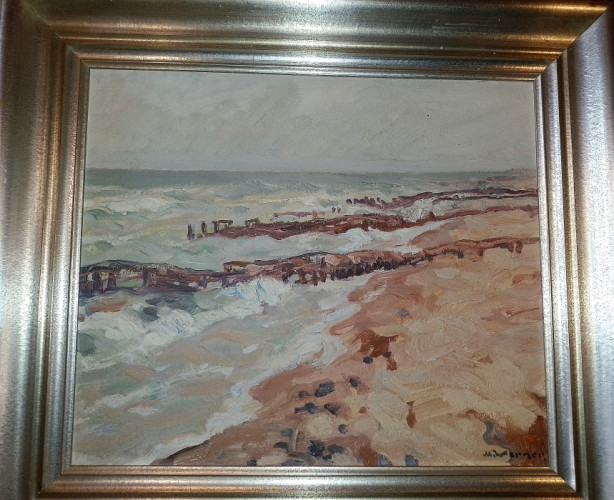
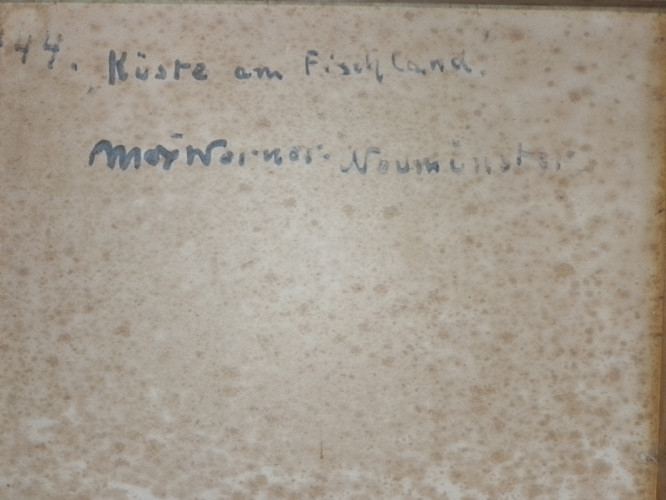
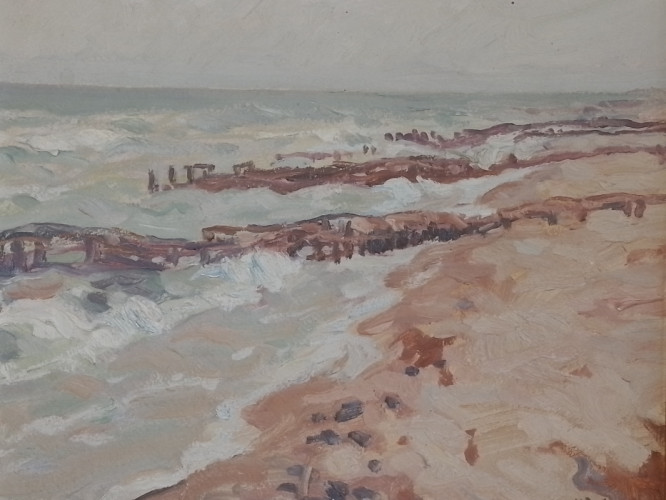
Oil painting, stormy day on the Baltic Sea in Fischland by:
In typical relaxed post-impressionist style, Max Werner captured this day on the beach impressively. Werner
1879 Staucha (Saxony) – 1952 Neumünster (Holstein)
Max Werner is associated with an important chapter in North German painting from the first half of the 20th century. The artist, who was born in Staucha, found his true artistic home in Holstein and shaped the cultural life of the city of Neumünster for decades.
Werner received his education at the Berlin Academy, where he studied with Walter Leistikow, among others. Leistikow's atmospheric conception of landscape left clear traces in Werner's work: the sensitive observation of light and atmosphere became a central concern of his work.
From 1906, Werner initially worked as a freelance artist in Reinbek near Hamburg. In 1915, military service took him to Neumünster - a place that from then on became the center of his life and artistic sphere. After the First World War he settled there permanently.
In the 1920s and 1930s he created a diverse oeuvre that includes landscapes, portraits as well as industrial and city views. Werner captured the northern German landscape with its wide fields, farms and sky scenes as well as the changing industrial character of Neumünster. His works combine an impressionistic, light-filled color scheme with a solid graphic structure. The loose brushwork gives the images liveliness, while the composition and choice of motifs demonstrate close observation of nature.
In addition to free landscape depictions, Werner created numerous commissioned works, including portraits of local personalities and views of factories and businesses. His work documents not only the moods of the landscape, but also the economic and social changes of his time.
Werner was a member of various artists' associations, including the Schleswig-Holstein Artists' Cooperative and the Reich Association of Visual Artists. His works can now be found in the Cloth and Technology Museum and Gottorf Castle, among others.
Max Werner left behind an oeuvre that, in its combination of atmospheric landscape painting and regional identity, is still recognized today as an independent contribution to North German art history.
In typical relaxed post-impressionist style, Max Werner captured this day on the beach impressively. Werner
1879 Staucha (Saxony) – 1952 Neumünster (Holstein)
Max Werner is associated with an important chapter in North German painting from the first half of the 20th century. The artist, who was born in Staucha, found his true artistic home in Holstein and shaped the cultural life of the city of Neumünster for decades.
Werner received his education at the Berlin Academy, where he studied with Walter Leistikow, among others. Leistikow's atmospheric conception of landscape left clear traces in Werner's work: the sensitive observation of light and atmosphere became a central concern of his work.
From 1906, Werner initially worked as a freelance artist in Reinbek near Hamburg. In 1915, military service took him to Neumünster - a place that from then on became the center of his life and artistic sphere. After the First World War he settled there permanently.
In the 1920s and 1930s he created a diverse oeuvre that includes landscapes, portraits as well as industrial and city views. Werner captured the northern German landscape with its wide fields, farms and sky scenes as well as the changing industrial character of Neumünster. His works combine an impressionistic, light-filled color scheme with a solid graphic structure. The loose brushwork gives the images liveliness, while the composition and choice of motifs demonstrate close observation of nature.
In addition to free landscape depictions, Werner created numerous commissioned works, including portraits of local personalities and views of factories and businesses. His work documents not only the moods of the landscape, but also the economic and social changes of his time.
Werner was a member of various artists' associations, including the Schleswig-Holstein Artists' Cooperative and the Reich Association of Visual Artists. His works can now be found in the Cloth and Technology Museum and Gottorf Castle, among others.
Max Werner left behind an oeuvre that, in its combination of atmospheric landscape painting and regional identity, is still recognized today as an independent contribution to North German art history.